PAF chief visits US to seek deeper defence ties
PAF chief visits US to seek deeper defence ties

ISLAMABAD:
Days after the army chief’s unprecedented visit to Washington, Air Chief Marshal Zaheer Ahmed Baber Sidhu, Chief of the Air Staff, undertook an official visit to the United States in yet another significant development aimed at strengthening bilateral defence cooperation and advancing mutual interests.
This was the first visit by a serving PAF chief in over a decade, indicating the stepped up military engagements between Pakistan and the US.
“The high-profile visit marked a strategic milestone in Pakistan-US defence cooperation and proved instrumental in deepening institutional ties in addition to addressing key regional and global security issues,” read a statement issued here on Tuesday by the Inter-Services Public Relations (ISPR).
There has been renewed interest in Pakistan after it inflicted heavy military losses on India in May during the four-day military conflict. Pakistan Air Force’s spectacular success against Indian Air Force on the night of May 6 and 7 took many, particularly the western countries, by surprise.
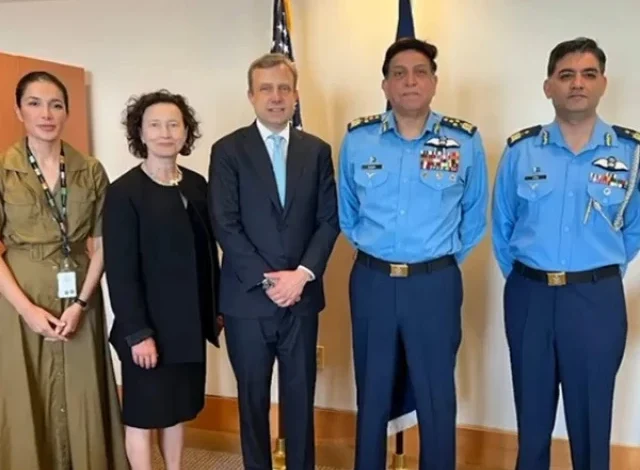
According to the ISPR, during the visit, Chief of the Air Staff held a series of high-level meetings with senior U.S. military and political leadership. At the Pentagon, he called on Ms Kelli L. Seybolt, Secretary of the Air Force (International Affairs), and General David W. Allvin, Chief of Staff of the United States Air Force. During the meetings the discussions centered around advancing bilateral military cooperation, enhancing interoperability and exploring avenues of joint training & technology exchange.
Chief of the Air Staff highlighted the historic and multifaceted relationship between Pakistan and United States, particularly in the domains of defence and security cooperation. He reiterated his resolve to further enhance the existing ties in the realms of military-to-military cooperation and training between the Air Forces of the two countries.
The two sides also agreed upon the continuation of high-level military engagements in future through senior-level interactions. “These interactions are deemed crucial for maintaining momentum in the ongoing cooperative endeavours in the areas of joint training, operational exercises and military exchange programs between the two nations,” it said.
At the US State Department, the Air Chief met with Mr. Brown L. Stanley from the Bureau of Political-Military Affairs and Mr. Eric Meyer from the Bureau of South & Central Asian Affairs.
The meetings served as a forum to underscore Pakistan’s constructive role in promoting regional stability, its firm commitment to counterterrorism efforts and its nuanced perspective on the evolving geopolitical dynamics of South and Central Asia. As part of his engagements at Capitol Hill, Chief of the Air Staff held substantive dialogues with prominent members of the U.S. Congress including Mr. Mike Turner, Mr Rich McCormick and Mr Bill Huizenga.
These interactions reinforced the importance of robust engagement in strengthening bilateral relations and provided a valuable opportunity to share Pakistan’s views on strategic challenges, regional security frameworks and the impact of emerging technologies on defence cooperation.
Emphasizing Pakistan’s status as a peace-loving nation, the air chief reaffirmed the country’s enduring sacrifices and notable operational achievements in the global war on terror, while also outlining Pakistan’s evolving security calculus in response to the rapidly shifting regional geopolitical landscape.