‘52% duty cut to boost exports’
Ministry projects revenue to grow 7-9%, but parliament questions WB model

ISLAMABAD:
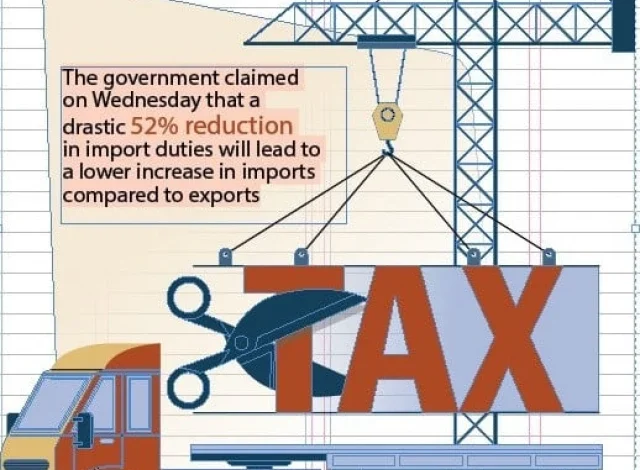
The government on Wednesday claimed a drastic 52% cut in import duties will lead to exports rising faster than imports, while revenues will grow by one-tenth. However, it admitted these projections are based on calculations by the World Bank.
Proceedings of the National Assembly Standing Committee on Finance revealed that the government is venturing into uncharted territory, largely relying on the World Bank’s Global Trade Analysis Project (GTAP) model.
The committee was briefed by the Ministry of Commerce on the new National Tariff Policy, which is being described as “Pakistan’s East Asia moment” aimed at increasing exports and reducing the trade deficit.
Under the new policy, the average applied tariff rate will fall from 20.2% to 9.7% over five years — a 52% drop — Secretary Commerce Jawad Paul told the committee. He claimed exports will rise at twice the pace of imports due to tariff reforms.
According to the GTAP model, exports are expected to grow 10-14%, while imports would rise only 5-6%, said Paul, adding this would help improve the trade deficit despite a lower protection level.
When asked about these projections, Finance Minister Muhammad Aurangzeb said, “These are assumptions — some may work and some may not.”
Leader of the Opposition Omar Ayub Khan raised concerns about the implications of reduced tariffs on reserves, inflation, exports, and imports. He questioned the assumptions behind the optimistic forecast and asked how such drastic tariff cuts could lead to higher exports without hurting reserves.
The government failed to provide clear answers and admitted that the World Bank developed the numbers using its GTAP model. Khan demanded the model be shared with the committee.
The government did not present the model at the meeting and instead promised a separate briefing by the World Bank and commerce minister. Khan insisted the briefing be open to the media, but Aurangzeb said the World Bank may not agree.
Concerns were raised over foreign consultants using a one-size-fits-all approach that ignores Pakistan’s ground realities. Officials from the finance ministry, Federal Board of Revenue (FBR), and commerce ministry could not clearly explain the impact on inflation, imports, reserves, or fiscal balance.
“Trade tariff reform will be painful as inefficient firms will shut down,” said FBR Chairman Rashid Langrial.
Secretary commerce said that in the first year (FY26), the tariff rate would drop to 15.7%, cutting the protection wall by 22.3%. This will be achieved by reducing average custom duty to 11.2%, additional custom duty to 1.8%, and regulatory duty to 2.7%.
PPP MNA Nafisa Shah noted that while the world is moving towards protectionism, Pakistan is granting unilateral concessions by reducing tariffs.
Pakistan’s issue has been high tariffs, and despite concerns, there is a need to lower protection under the Most Favoured Nation (MFN) regime of the World Trade Organisation (WTO), said Paul.